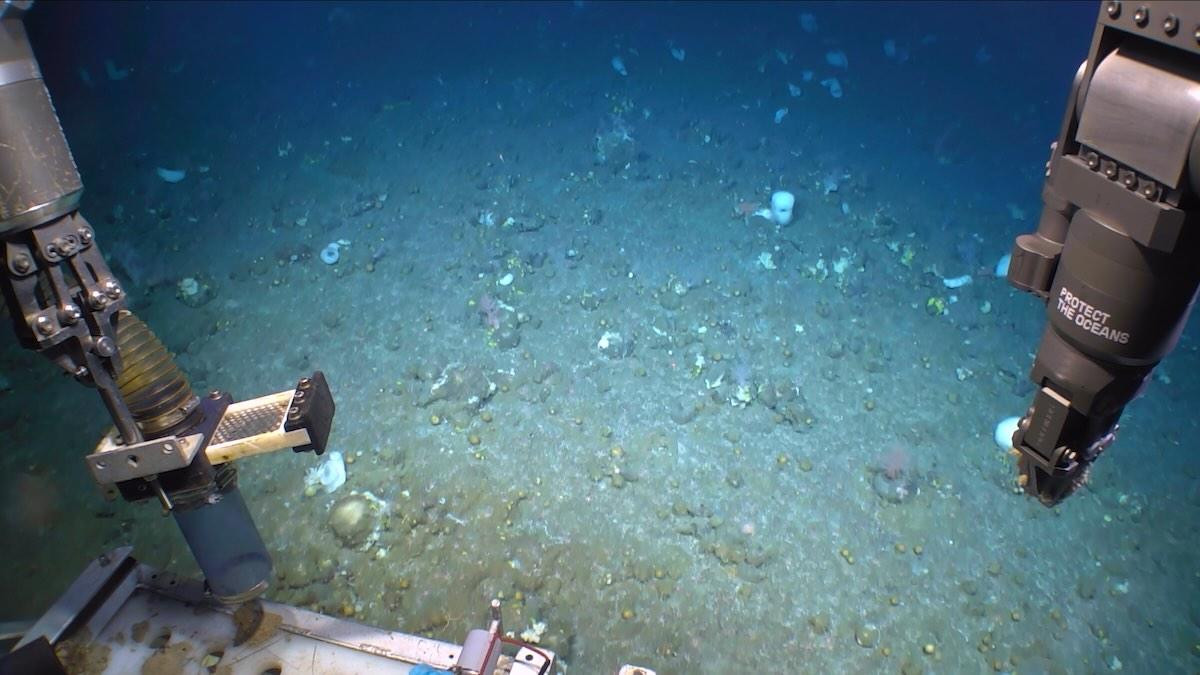
During an ongoing deep-sea expedition, researchers have discovered several previously unknown species in the Arctic deep sea. Paco Cardenas is a taxonomist and expert on sponges at Uppsala University, and in just a few days has identified at least three species that have yet to be named.
Together with his postdoctoral researcher, Julio A. Díaz, he is aboard the environmental organisation Greenpeace’s research vessel, which will spend a month exploring deep-sea locations that no one has visited before. These include underwater mountains and hydrothermal vents at depths of over a thousand metres, from which they can take samples using an underwater robot.
“We’re trying to collect as many sponges as possible and identify them on board. And we already have what could be at least three new species for science,” says Paco Cardenas.
Hidden ecosystems teeming with life
In the Arctic, Norwegian and German research expeditions in particular have been launched in recent years to try to better understand deep-sea habitats. This makes the region a relatively well-studied area, but given its vast size, there is still a great deal left to discover.
“Today we are on an unnamed underwater mountain, which means it has been mapped at some point, but no one has come to explore it. We are the first people to see what it looks like,” says Paco Cardenas.
Minerals that attract life – and investors in mining
The area the researchers are investigating is very rich in minerals, such as manganese and copper. This makes the area rich in life, but the minerals can also be used in the production of, among other things, electric car batteries and wind turbines. This makes the area of interest to stakeholders wishing to explore the potential for deep-sea mining there.
However, deep-sea mining in areas such as these would likely lead to a decline in deep-sea biodiversity, according to a recently published study in the scientific journal Current Biology.
About Deep Sea Reporter: Our ambition is to examine and report on issues related to the sea and the life that exists beneath its surface. We operate in the public interest and are independent of political, commercial, and other interests in society.