The Rhetoric is Heating up Over the Russian Shadow Fleet in the Baltic Sea
Text: Judith Vincent
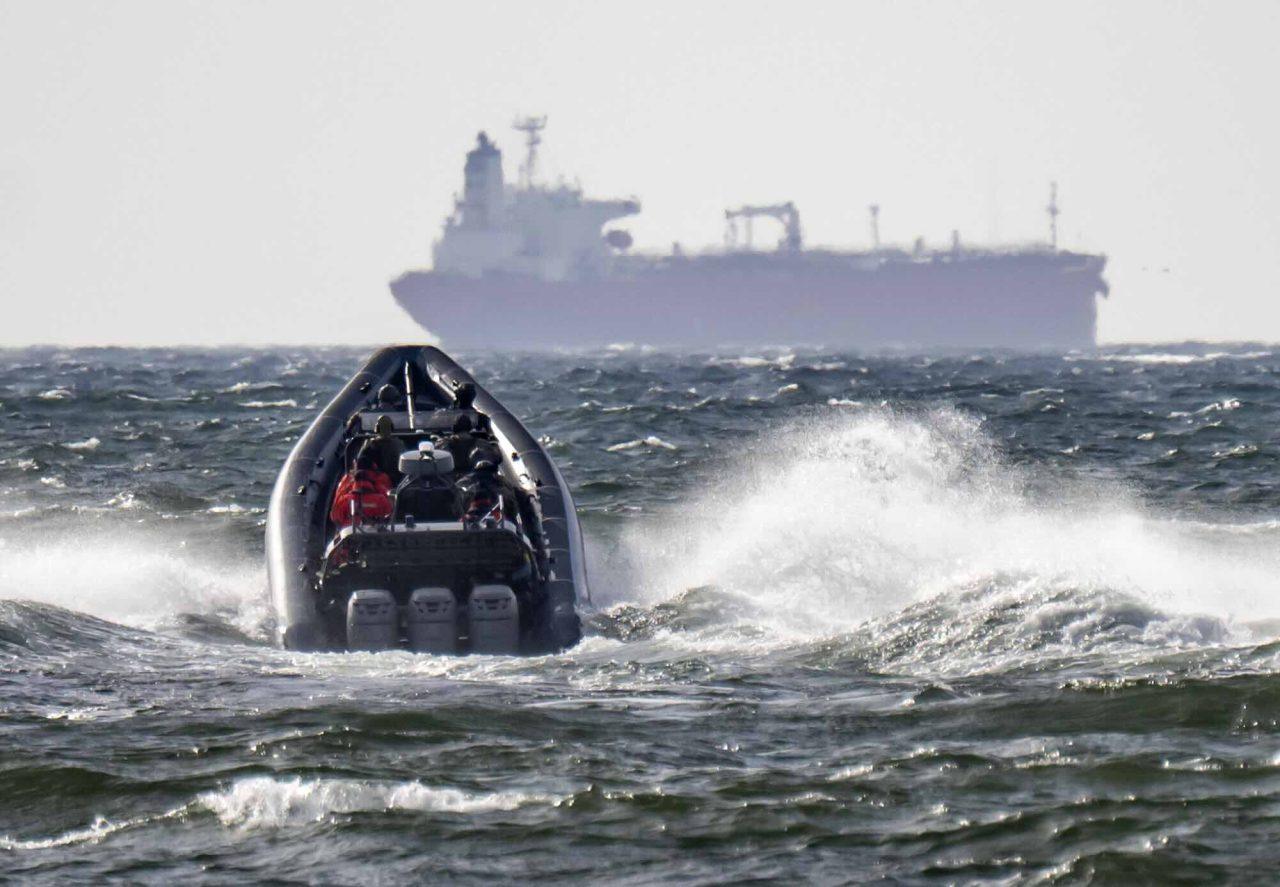
Two vessels suspected of belonging to the Russian shadow fleet remain off the coast of Trelleborg. In March 2026, the Swedish authorities boarded the vessels, which are believed to be transporting Russian oil under a false flag. Russia regards this type of action as piracy.
Deep Sea Reporter spoke to Linus Fast at the Swedish Defence Research Agency (FOI) about the escalating security situation in the Baltic Sea region. Among other things, he warns of the poor condition of Russian vessels, which could affect both the environment and infrastructure in the Baltic Sea, and emphasises the need for joint and clear action from the EU to stop the dangerous shadow fleet.
The two vessels have been seized and ordered to remain at anchor. They are being monitored by the Swedish Coast Guard in the area. Meanwhile, investigations are underway under the Swedish legal system to determine whether any offence has been committed. The intervention was possible because the ships were in Swedish territorial waters.
The security situation between Russia and the EU is now escalating after certain EU countries have not only been monitoring and tracking the routes of Russian vessels in the Baltic Sea, but also carrying out raids on suspected ships.
Russia is attempting to counter this by, on the one hand, having its Baltic Fleet carry out what they call maritime security operations – which involves escorting the shadow fleet – and, on the other hand, stationing armed Russian personnel on some of the vessels, explains Linus Fast.
No common practice within the EU
According to Linus Fast, there is as yet no common practice within the EU for dealing with issues surrounding the Russian shadow fleet, which complicates the situation. However, a first step was taken in January this year. All Baltic and North Sea nations, with the exception of Russia, signed a proclamation stating that they no longer accept inadequate maritime safety in the region.
‘Outside territorial waters, the laws of the flag state apply; within them, the laws of the coastal state apply. According to the UN and international maritime law, it is up to each individual nation to ratify the Convention on the Law of the Sea and – if so – transpose it into national legislation.’
Such national implementation varies slightly depending on different nations’ interpretations. It would be beneficial if the EU could take the initiative to harmonise the individual nations’ interpretations and national legislation, believes Linus Fast.
Environmental crimes and maritime safety issues could be the key
EU countries could make use of the UN Convention on the Law of the Sea, which sets out the rules governing environmental and maritime safety issues beyond the limits of territorial waters. The application of the law often involves interpretation, and that is where we actually see a difference, explains Linus Fast.
Belgium was the first to test the new proclamation. They seized a vessel from the suspected Russian shadow fleet that was located outside Belgian territorial waters, but within the so-called Belgian exclusive economic zone.
According to Linus Fast, the law of the sea can be interpreted broadly, meaning that a coastal state has a certain degree of jurisdiction regarding environmental offences.
‘It is not self-evident that one is permitted to intervene, but an interpretation of the law of the sea implies that if environmental offences can be demonstrated, one may intervene. In one’s own territorial waters, it is much simpler – there, it is sufficient to invoke maritime safety, for example. But a coastal state has a certain ability to exercise jurisdiction regarding environmental offences even within its exclusive economic zone.’
This should be utilised more ‘proactively’ and, ideally, in coordination with neighbouring states in the Baltic Sea region, says Linus Fast.
The shadow fleet
The main reason for the emergence of the Russian shadow fleet is that Russia wants to sell its oil and bring money into the state coffers. The first EU sanctions were introduced in 2014 following Russia’s annexation of the Crimean Peninsula and were expanded in 2022 following the war of aggression against Ukraine.
‘The EU and G7 introduced a price cap on Russian oil exports. To circumvent the price cap, Russia has purchased, and additionally chartered, a large number of vessels – at least 500 but likely just over 1,000 – from various nations to export and sell oil under false flags.‘
The shadow fleet is mainly used in the Baltic Sea, but also in the Black Sea. Broadly speaking, the Russian export economy is based on fossil fuels – oil and gas – but there may also be some arms exports on board these ships.
‘The false flag can be just about anything; the point is that it is the flag state’s jurisdiction that applies on board the vessels.’ With false flagging, jurisdiction and liability, for example in the event of an accident, become unclear, notes Linus Fast.
The ability to export oil determines the intensity with which Russia can wage war in and against Ukraine. Linus Fast estimates that energy exports may account for a third of Russia’s public finances.
‘Russia will do everything in its power to continue exports. They have no alternative; the state finances are heavily dependent on getting the oil to market, and Russian oil exports may even increase now given the situation in the Strait of Hormuz and the conflict in Iran. Global oil prices are now rising.’
According to Linus Fast, the biggest buyers of oil and gas from the Russian shadow fleet are China. Turkey also buys the oil, refines it into more refined products and resells it to a number of EU countries.
‘This is because there is an enormous energy demand in the EU and globally that has not been met by any other means.’ It is not just Hungary and Slovakia in the EU that are ‘huggers’ of Russian energy, asserts Linus Fast.
Ships in poor condition with slave-like working conditions
The Russian shadow fleet forms part of the international merchant fleet.
Many operators use flags of convenience for financial reasons, where the flag state offers low costs through lax requirements and limited checks regarding maritime safety and working conditions on board the ships. Panama, Liberia and the Comoros are examples of countries that allow others to register their ships under their flag.
The ships are manned by low-wage labour, for example from the Philippines and Bangladesh.
‘It is not only the ships that are substandard. In many cases, the crew lack the knowledge equivalent to a seafarer’s training, and the sailors work under conditions bordering on slavery for a very low wage.’
According to Linus Fast, it is difficult to prove who owns the ships, but if authorities in EU countries can demonstrate serious safety and working environment deficiencies, as well as a threat to the marine environment, more ships could be stopped.
‘The major risk right now, not least from an environmental perspective, is that if an accident were to occur, such as an oil spill, we could face an environmental disaster.’
Risks to the environment and infrastructure
Generally speaking, there is a significant environmental impact on the Baltic Sea due to the extensive and growing volume of shipping traffic.
In addition to potential oil spills, there is also a growing risk of damage to vital infrastructure.
Linus Fast believes that many people working in civil defence do not realise how the presence of shadow ships also affects safety on land. Several of the shadow ships have lost their anchors, either intentionally or unintentionally, which has destroyed seabed infrastructure, including communication cables and gas pipelines.
Both Sweden and Finland have attempted to investigate whether this was deliberate and therefore criminal, or whether, as the crews themselves claim, it was an accident.
These cases have not led to prosecution because the incidents occurred outside territorial waters and the coastal states therefore lack jurisdiction.
‘In principle, one could apply the flag state’s legislation and compel them to act, as has been done in an ongoing case in China. However, holding a flag state accountable is difficult as these are cases of false flagging. This is why the possibility of classifying these vessels as stateless under the UN Convention on the Law of the Sea has now been raised.’
There are also tens of thousands of sea mines remaining on the seabed of the Baltic Sea, not least in the Gulf of Finland, laid during the First and Second World Wars.
‘There is a risk that lost anchors dragging along the seabed may pick up mines that could drift and surface anywhere.’
Hybrid warfare
Linus Fast speculates that some of the shadow fleet vessels are deliberately being used to create uncertainty and stress in the Baltic Sea region, as part of Russian hybrid warfare.
In September 2025, air traffic at Kastrup was halted for a few days after drones were spotted. Danish authorities suspected that a vessel from the Russian shadow fleet was being used as a mother ship.
Uncertain future
Linus Fast believes it will be interesting to follow developments and see how Sweden and other EU countries act going forward.
‘It would be good if more nations followed the example of Belgium and Sweden and set an example, but we can probably expect reprisals and further acts of sabotage from the Russian side.’
Cover image: A seagull on a Baltic Sea beach. Archive image.
About Deep Sea Reporter: Our aim is to investigate and report on issues relating to the sea and the life that exists beneath the surface. We operate in the public interest and are independent of political, commercial and other interests in society.