Lowest summer flow in Europe’s rivers in over 30 years – according to a new report
Prolonged heatwaves and widespread drought characterised the summer in Europe. A new report from the EU’s Copernicus Climate Service shows that this also led to several record-breaking high temperatures in the oceans and very low water levels in Europe’s largest rivers.
Text: Amanda Saveland
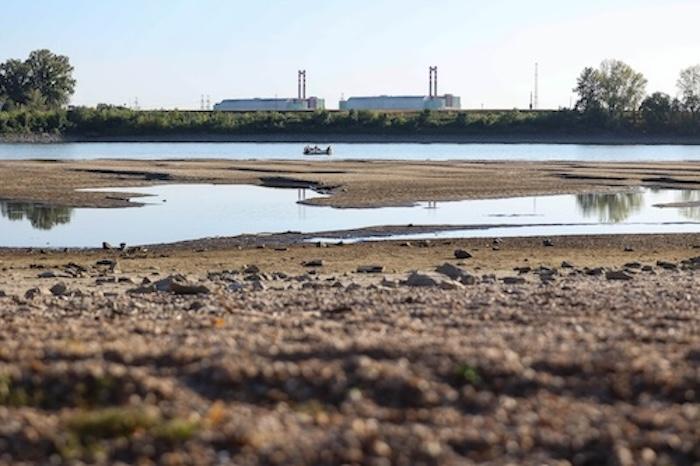
This summer was the third hottest on record in Europe, and the hottest ever in Western Europe. As early as May, the first severe heatwave swept across the continent, and towards the end of the summer, the consequences began to be clearly visible in Europe’s rivers. Rusty hulls from a Nazi fleet, which had lain hidden at the bottom of the Danube for over eighty years, were exposed when water levels reached record lows in Serbia. And outside Budapest in Hungary, the tourist boats that normally ply the river had to cancel their routes, as there was no water to navigate on.
A summer of climate extremes
The fact that this was an extreme drought has now been confirmed by the EU’s Copernicus Climate Service, which states that water levels in Europe’s rivers were the lowest recorded since measurements began in 1992.
“Europe experienced a summer characterised by a combination of extreme weather conditions. Record-high heat stress, widespread drought, exceptionally low water flows and unusually warm seas occurred simultaneously across large parts of the continent,” says Samantha Burgess, Strategic Director for Climate at Copernicus, in a press release.
Major socioeconomic impact
The Danube, the Seine, the Loire and the Rhine all suffered record-low, or near-record-low, water levels in July and August. This not only highlighted Europe’s war-torn history and brought tourist excursions to a halt, but also laid bare the central role that rivers play in industry, transport and energy supply.
France, which accounts for half of the EU’s total nuclear electricity generation, was forced to shut down several reactors over the summer due to a lack of water to cool them. And in Romania, in early August, the military used 180 kilograms of explosives to divert water into a canal, thereby preventing a total shutdown of the Cernavoda nuclear power station.
Crisis facing cargo ships
The dried-up rivers also caused freight problems, as much of Europe’s transport takes place by water.
On the Rhine, Western Europe’s largest river, ships were forced to reduce their cargo capacity by a fifth to avoid running aground, which caused production disruptions for several industries.
“The consequences go beyond mere heat records. They affect access to water, energy systems, transport, ecosystems and human health, and as the climate continues to warm, events such as these underscore the need to build resilience to increasingly interconnected climate risks,” says Samantha Burgess.
Record heat in the Mediterranean
The hot summer also affected Europe’s seas, where surface water temperatures across large parts of the Atlantic coast and in the western and central Mediterranean reached record levels, accompanied by severe marine heatwaves.
In parts of the Mediterranean, the water was up to 6 degrees above normal. This would not have been possible without human influence on the climate, according to the research network World Weather Attribution.
These record-breaking ocean temperatures are having devastating consequences for life beneath the surface. This is partly due to heat stress and partly because warm water produces less oxygen, thereby causing oxygen depletion.