This is Where Greenhouse Gases Can be Stores in the Baltic Sea
The search for sites in Sweden where carbon dioxide can be stored beneath the seabed has been underway for three years. Two potential sites have now been identified.
‘We’ve received some excellent samples and the results so far are very promising,’ says Sofie Lindström of the Geological Survey of Sweden (SGU).
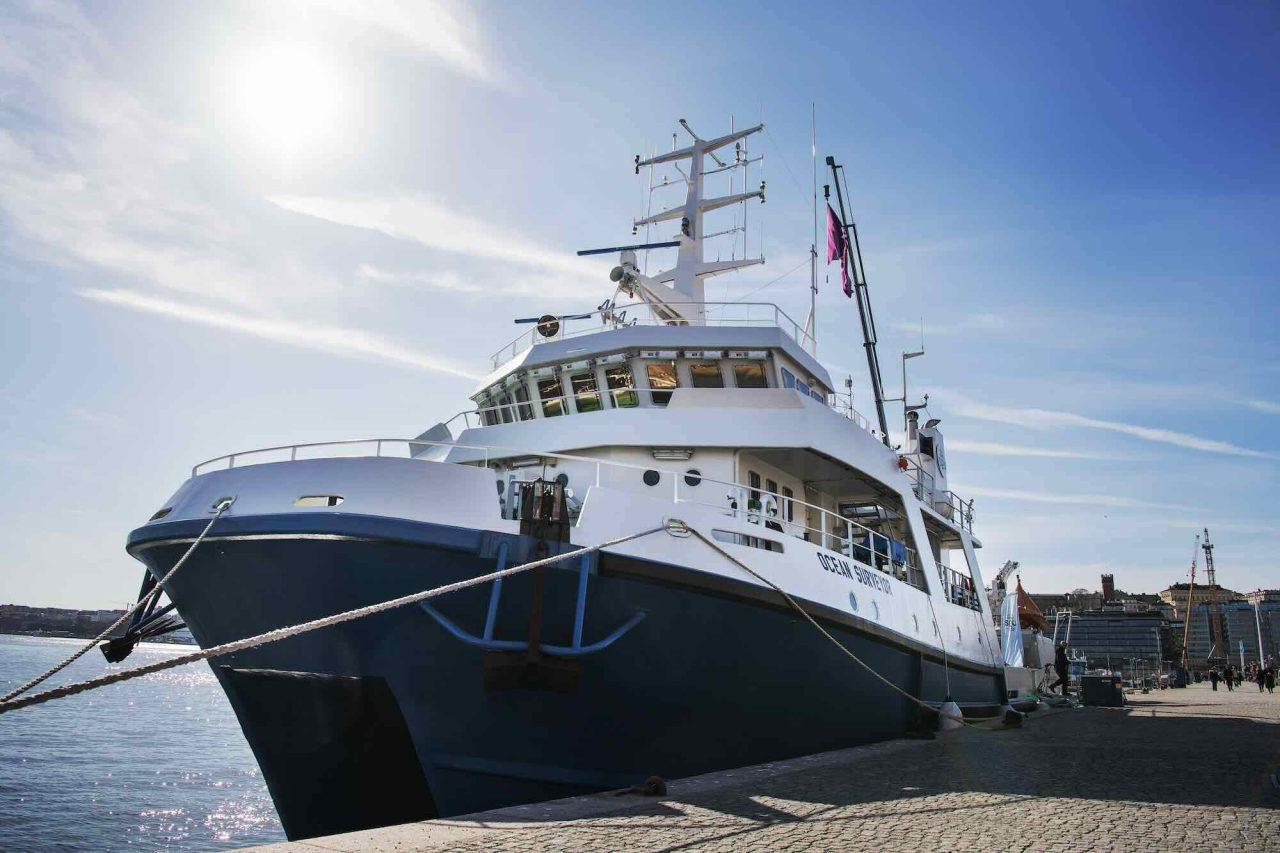
Photo: Viktoria Bank/TT
Capturing carbon dioxide from chimneys and then storing it underground has been identified as a key component in slowing down global warming, and also in achieving Sweden’s climate target of net-zero emissions by 2045.
It is not currently permitted to store carbon dioxide on land; therefore, the Swedish Geological Survey (SGU) has, as part of a government commission, investigated an area in the Baltic Sea south-east of Gotland and south of Skåne.
The SGU estimates that more than 5 million tonnes of carbon dioxide per year could be stored at the two sites combined. This can be compared with Sweden’s total emissions of 47.5 million tonnes in 2024.
This would roughly correspond to what Sweden’s shipping sector emits in a year. In that case, the distribution could be a slightly smaller portion off Skåne and a larger portion in the south-eastern Baltic Sea, says Sofie Lindström, state geologist and project manager.
The carbon dioxide spreads through the porous rock, reacting with it over hundreds of years and eventually mineralising. Above these areas lie denser rock formations, which keep the molecules in place.
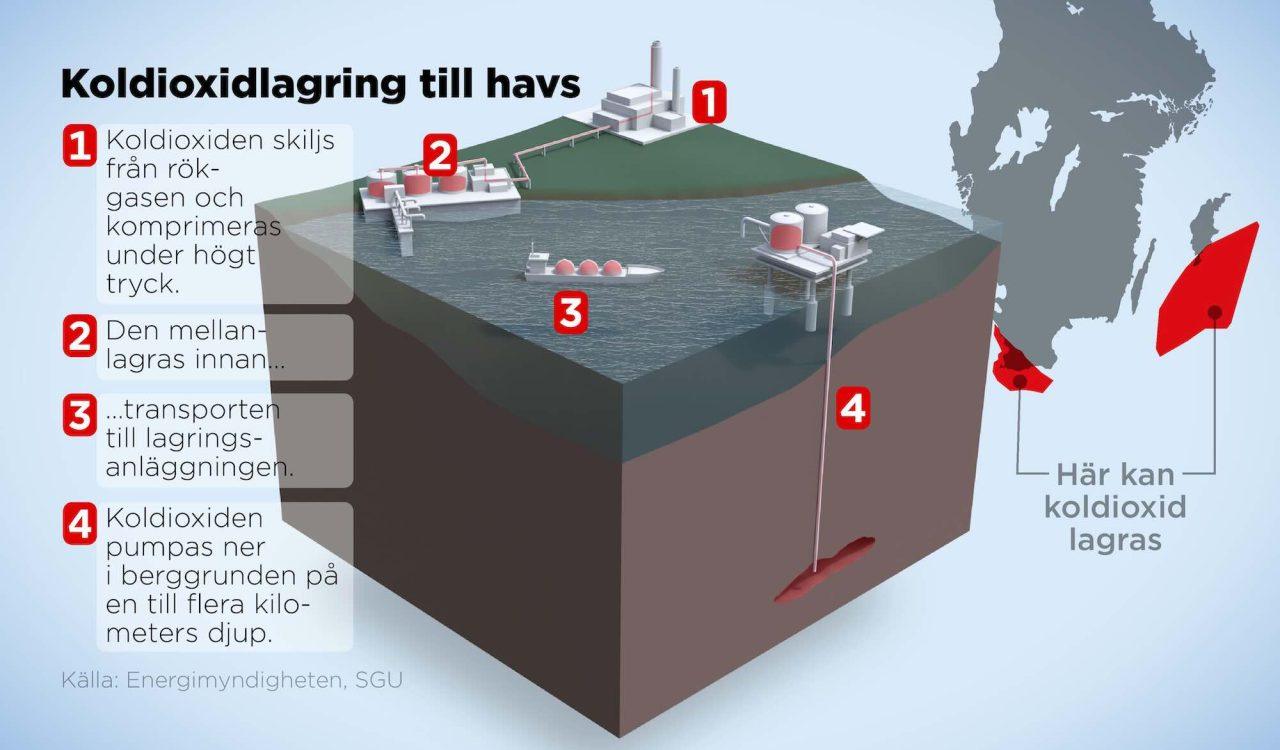
Graphics: Anders Humlebo/TT
1. The carbon dioxide is separated from the flue gas and compressed under high pressure.
2. It is temporarily stored before…
3. …being transported to the storage facility.
4. The carbon dioxide is pumped into the bedrock at a depth of one to several kilometres.
Source: Swedish Energy Agency, SGU
Two proposals were rejected
As part of the SGU’s work, new drill cores have been taken off the coast of Trelleborg and in southern Gotland, and surveys have been carried out using vessels in these areas. This has been combined with older data.
In the large area off the coast of Gotland, three different sites have been investigated. Two of them have been ruled out.
‘It is normal to sometimes find things that are not as good as you initially thought,’ says Sofie Lindström.
The third – known as the Faludden sandstone – appears to be suitable. It should be possible to inject 300 million tonnes of carbon dioxide there over a period of 30 years.
‘It is a very good reservoir rock,’ says Lindström.
Simulations of the area in the south-western Baltic Sea suggest that this area could store more than 100 million tonnes of carbon dioxide over the same period.
More testing is needed
There is still a long way to go. The SGU needs to carry out further investigations. After that, companies wishing to store carbon dioxide must apply for a licence, gain approval and build the infrastructure – drilling holes in the seabed and ensuring that the carbon dioxide is transported there from ships or possibly from land.
‘I would guess it will take at least ten years,’ says Lindström.
Cover image: From 2028, the combined heat and power plant at Värtahamnen in Stockholm will capture carbon dioxide, with a view to eventually storing it beneath the seabed. Archive image. Photo: Anders Wiklund/TT
CCS stands for carbon capture and storage, i.e. the capture and storage of carbon dioxide.
The carbon dioxide is captured from flue gases and compressed under high pressure until it becomes liquid.
It is then transported via an interim storage facility to a permanent storage site one to several kilometres below the seabed, where it eventually turns to stone.