

Ocean devotion: Dr. Richard Smith.
The ocean’s tiniest seahorses are drawing global attention thanks to a pioneering work of Dr. Richard Smith, a British marine biologist and underwater photographer. He has become the world’s leading authority on pygmy seahorses.
Text: Judith Vincent
Meet Dr. Richard Smith – a British award-winning underwater photographer, author, and marine biologist, devoted to the conservation of The World Beneath. That is also the title of his book. Richard Smith has a bachelor’s degree in Zoology, a master’s degree in Marine Ecology and Evolution, and a PhD that he received for his pioneering research on pygmy seahorses; the first PhD ever awarded for the subject.
It all started some 20 years ago, when Richard Smith was searching for a PhD position to continue his marine biologist journey in Australia. As he started to think about what would be interesting and important to study, and on the same time something he could be “super passionate about”, he ended up going, as he says “down the crazy road of pygmy seahorses”.
No one had ever studied the tiny creatures measuring about a thumbnail long. That became his call, as he pioneered the rout to his later on involvements in the findings of two new species: the Japanese Pygmy Seahorse (Hippocampus japapigu, discovered 2018), and the Sodwana Pygmy Seahorse (Hippocampus nalu, described 2020). The latter is the newest to the pygmy seahorse family, and the first one to be found in the Indian Ocean, close to Mozambique on the eastern coast of South Africa.
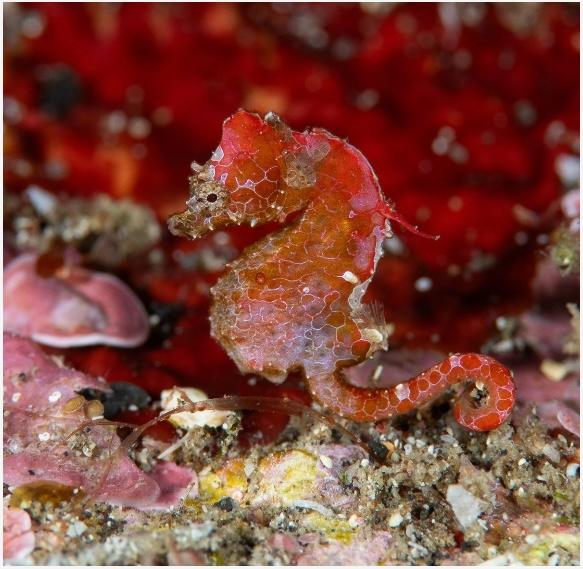
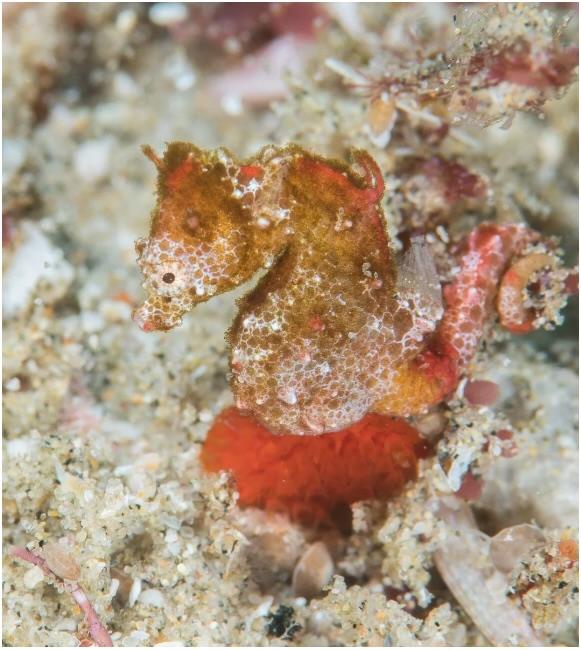
Pygmy seahorses have been found as deep as 120 metres, but usually they live at about 20 metres depth.
The first pygmy seahorse was discovered and named in 1970. Because they are so small, it took more than three decades to discover the next one.
For his PhD work, Richard Smith focused on the studies of the two species that live on gorgonian corals, at 8-10 metres depth. He spent hundreds of hours just watching and recording. Part of the work was observing the reproductive and social behaviours.
A different reproduction behaviour
Spending so much time in the water with these elusive creatures made Richard an expert at finding them. It has always been known that all the seahorses are faithfully monogamous, which is very unusual in nature. But Richard Smith found that these pygmies sometimes are sexually promiscuous. He explains that it is because they are stuck in their little groups on seafans their whole adult life.
‘I found one female mating ultimately with two different males, which is exciting if you’re in the world of seahorses’, he says.
‘It was obviously a different mating system than you normally find. So, the males were kind of competing between each other. And whilst, I don’t know, stags fight each other with their big antlers, the pygmy males were like strangling each other with their tails and stuff, which is pretty crazy to see. But very cool, it was really a privilege to see all that.’
After he finished his PhD, he was invited to join the International Union for Conservation of Nature (IUCN), where he is the lead scientist in the Seahorse, Pipefish and Seadragon Specialist Group. He works to advance the understanding and conservation of these species, often via citizen science through his expeditions.
Why should we care about tiny seahorses?
Our ecosystems are threatened, and even the tiniest little organisms are an important part of it. He believes that people do not care about things they do not know exist. And that people do not always know what we are losing. That is why he also became an author.
With his book The World Beneath: The Life and Times of Unknown Sea Creatures and Coral Reefs he is hoping to spark curiosity in the public. Because, when corals bleach, not only pygmy seahorses lose their homes, as coral reefs support some of the most biodiverse ecosystems on the planet. Through science, photography, and storytelling, Richard Smith is ensuring that some of the oceans tiniest residents are no longer overlooked.


