New Report: The Earth is out of Balance
Everything points in the wrong direction. Never before has the Earth’s climate been so out of balance, warns the World Meteorological Organisation (WMO).
In this year’s report, the WMO includes the Earth’s energy balance as one of the key climate indicators for the first time.
“This is yet another important indicator that gives us a picture of what is happening to the Earth’s system,” says Karina von Schuckmann, one of the researchers behind the report.
The Earth’s temperature changes depending on how quickly energy enters and leaves the system. In a stable climate, the energy coming in from the sun is roughly equal to the energy going out.
The imbalance has increased since measurements began in 1960, particularly over the last 20 years. It reached a new peak in 2025. Increased concentrations of greenhouse gases in the atmosphere are slowing the rate at which energy leaves the Earth’s system.
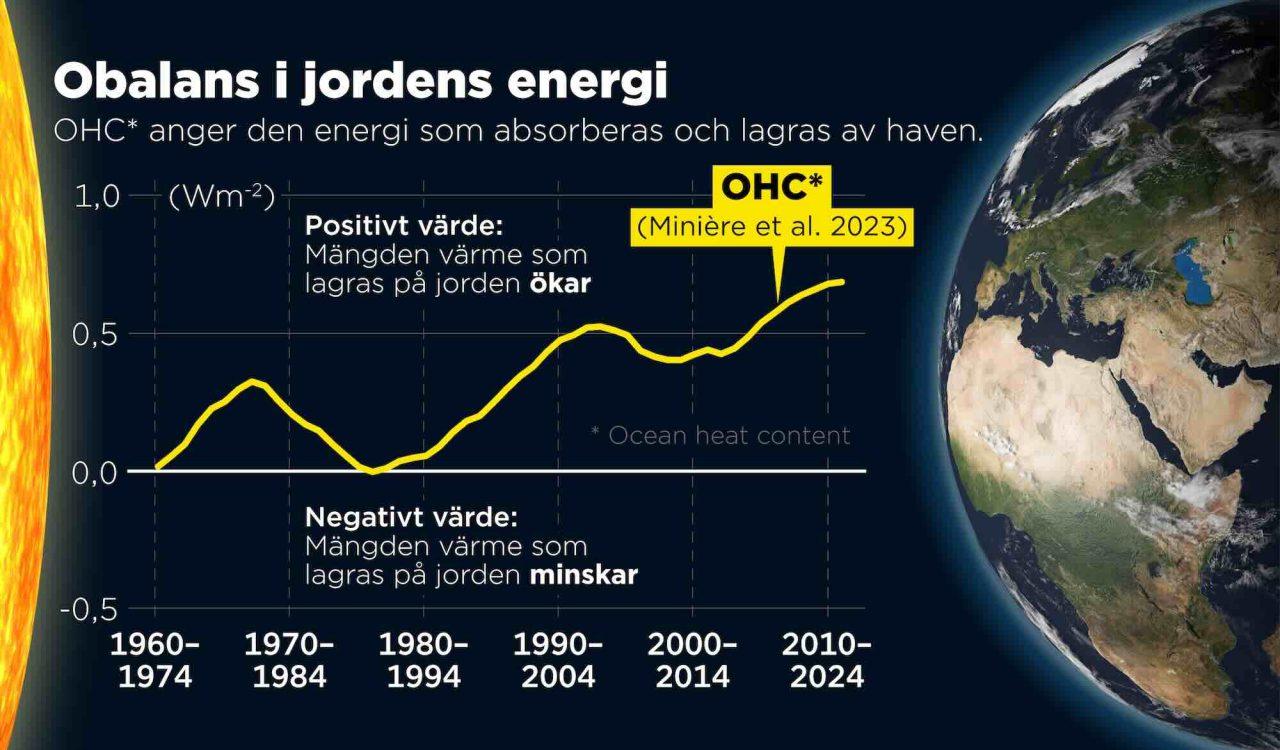
OHC (Ocean Heat Content) refers to the energy absorbed and stored by the oceans.
The heading says: An imbalance in the Earth’s energy
Pushed beyond limits
The report’s other indicators also paint a bleak picture.
“The Earth is being pushed beyond its limits. All key climate indicators are flashing red,” says UN Secretary-General António Guterres in a press statement.
Carbon dioxide, methane and nitrous oxide reached their highest levels in 800,000 years in 2024 – the most recent year for which globally compiled figures are available.
The last eleven years have also been the warmest on record. 2025 was marginally cooler than the record year of 2024 because the La Niña climate phenomenon temporarily brought lower temperatures.
The oceans, which act as a buffer against higher temperatures on land, are also getting warmer. Ocean heat reached a new record high in 2025. At the same time, sea levels continue to rise and glaciers and sea ice are disappearing.
Causing chain reactions
The report also highlights how extreme weather resulting from climate change affects people. When agriculture is affected, it triggers chain reactions such as food shortages, social instability and migration.
Health risks such as heat stress are also increasing, and the number of people infected with dengue fever is the highest on record, with roughly half the world’s population at risk.
The report is based on scientific contributions from national meteorological and hydrological services, the WMO’s regional climate centres, UN partners and other experts.
Cuts to climate research funding and reduced environmental budgets have not affected the data, says WMO Secretary-General Ko Barrett.
The good news is that we have not seen a decline in the flow of data or observations. Traditional sources remain available and continue to provide us with reliable data.
The imbalance in the Earth’s energy balance has increased since measurements began in 1960, particularly over the last 20 years.
In 2024, concentrations of methane and nitrous oxide reached their highest levels in the last 800,000 years.
The global average temperature over the last eleven years, 2015–2025, represents the eleven warmest years on record.
In 2025, ocean temperatures reached their highest level since records began 66 years ago. The rate of warming over the last two decades has been more than twice as high as during the period 1960–2005.
The loss of glacier mass between September 2024 and August 2025 ranks among the five worst on record. Losses in Iceland and along the Pacific coast of North America are described as exceptionally large.
In 2025, the annual average extent of sea ice in the Arctic was the lowest or second-lowest ever recorded, whilst the extent in Antarctica was the second-lowest ever observed.
The WMO is the UN’s meteorological organisation and has been publishing the ‘State of the Global Climate’ report since the 1990s.