Is the Gulf Stream at risk of collapsing? Scientists are deeply divided
Is the Gulf Stream on the verge of collapsing and causing chaos in the Earth’s climate? Several high-profile reports have warned that this is about to happen.
But this is one of the few climate issues on which the scientific community remains deeply divided.
The AMOC (Atlantic Meridional Overturning Circulation) is a network of currents in the Atlantic, both at the surface and at depths of several thousand metres. Warm surface water is carried northwards, cools at northern latitudes, sinks and returns southwards along the seabed.
The Gulf Stream is part of this northward surface flow, but is driven primarily by the winds and the Earth’s rotation. It will persist even if the AMOC weakens significantly.
Should the current system weaken significantly or collapse, it would have major consequences for the climate, not least in Sweden and the other Nordic countries, where, according to climate models, it would become considerably colder, particularly in winter.
If the AMOC weakens, the climate will be affected globally, not just in northern Europe. I think all researchers agree on that,’ says Léon Chafik, an oceanographer and climate researcher at Stockholm University.
But the question is whether this is happening, when it will happen and at what rate. It is very difficult to predict.
Just how far apart the researchers’ views are is already evident in the fundamental question: what exactly are we measuring?
Firstly – which AMOC are we actually talking about? There are different ways of defining it mathematically. Then there is the geographical question. Some talk about the AMOC at higher latitudes, others at lower latitudes. And there isn’t just one. There are AMOCs, in the plural, because the circulation behaves differently in different places.
What the researchers do agree on is just how much remains uncertain.
Research is scattered
Fabien Roquet, a professor at the Department of Marine Sciences at the University of Gothenburg, agrees that the state of research on the AMOC is uncertain.
It is difficult to observe the circulation as a whole, and we lack long, robust time series. It is also difficult to represent in models. Some models show a significant weakening, whilst others indicate considerably smaller changes.
There is a group of researchers who strongly emphasise the risk of a collapse. This must be taken seriously, but the overall scientific assessment is that the probability is very low and that, if it were to happen, it would be several decades in the future. At the same time, there are other major consequences of climate change that are already underway.
Fabien Roquet has studied the stratification of the world’s oceans – that is, how seawater of different temperatures and salinity levels forms distinct layers. A common hypothesis is that increased stratification in the North Atlantic weakens the AMOC circulation, but his findings call this view into question.
Stratification is increasing rapidly in certain areas, particularly in the tropical Pacific. However, in parts of the North Atlantic, we did not observe the same trend. There, stratification has changed relatively little, and in some places it has actually decreased.
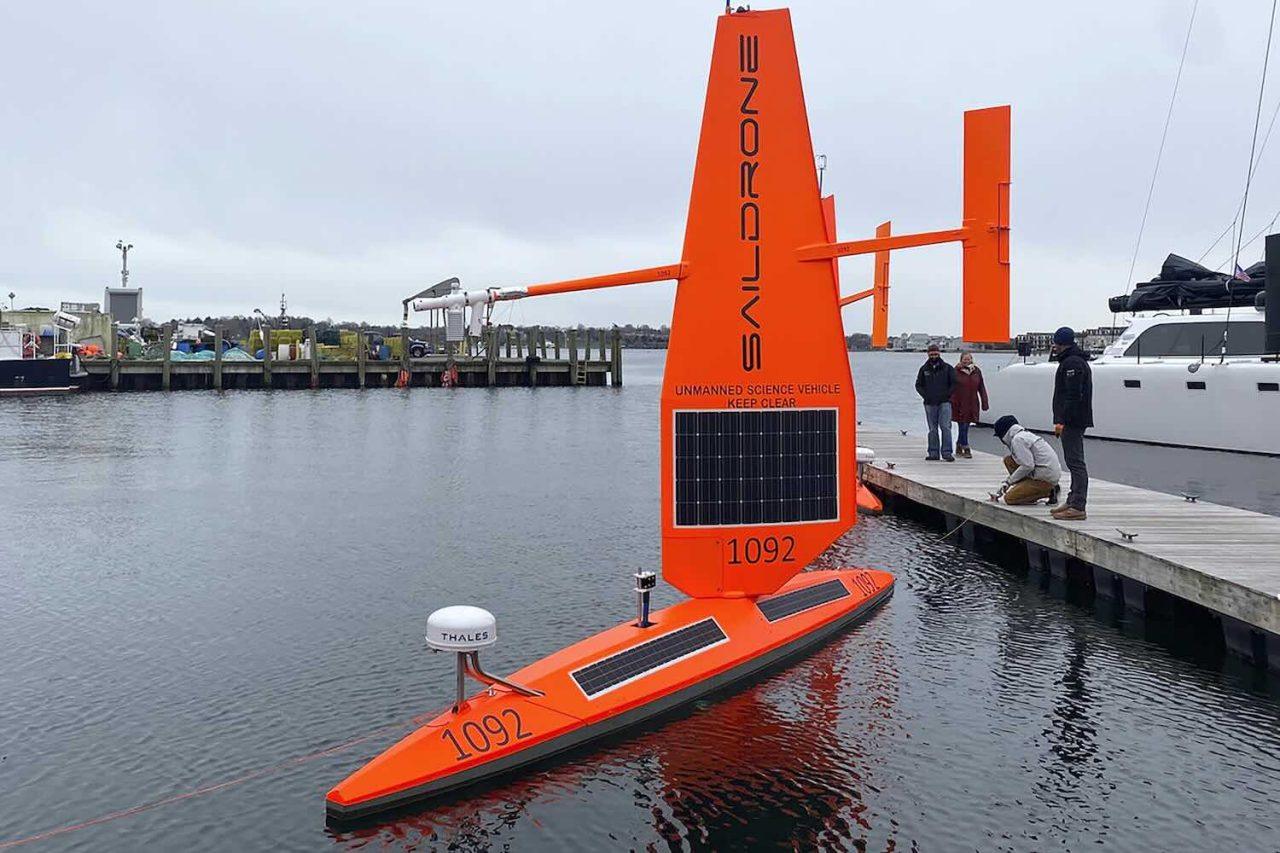
A marine drone will be launched in 2021 to travel along the Gulf Stream and collect data. Archive photo.
Measurement series are too short
Scientists agree that it is important to learn more about the system, and how – and whether – it is affected by global warming. But reports of a collapse and an impending ice age have diverted attention from just how much we actually do not know.
The first continuous measurements began in 2004, stretching from the coast of Florida to north-western Africa. They show how much water is flowing northwards in that specific area. In 2014, a monitoring programme was added further north, across the North Atlantic between Canada and Scotland. The measurement series are still too short to be able to reliably distinguish a long-term weakening from natural fluctuations, explains Léon Chafik.
The fundamental problem is that we have not been measuring for long enough. The natural variations can last 30 to 50 years, or even longer. This makes it difficult to say with certainty whether what we are seeing is natural variation or the start of a long-term weakening.
Furthermore, since the mid-1990s, instruments have been in place in the straits between Greenland, Iceland, the Faroe Islands and Scotland. There, warm water flows towards Norway and the Arctic, and cold water flows back out into the depths. These instruments show that the water has become warmer, but not that the flow has decreased.
Perhaps the system is more resilient than previously thought. But it may also be that what we are seeing right now is part of a much longer-term weakening.
Léon Chafik is one of several researchers who, in a report to the Nordic ministers, have sought to raise the AMOC issue at ministerial and EU level. The aim is to secure long-term funding to keep the measurements going.
The problem has been that researchers apply for funding to deploy these instruments. But applications must be made in cycles, and there are no guarantees that the measurements will be allowed to continue. If there are gaps in the measurement series, it will cost us in the long run.
A severe blow
The measurements were recently threatened when, in May, the Trump administration announced that it would be phasing out several ocean observatories within the Ocean Observatories Initiative (OOI), and that instruments and measuring stations would be removed. This was a severe blow, as the US is responsible for around half of the world’s ocean monitoring.
The protests were massive, and in June the National Science Foundation (NSF) announced that it was putting the plans on hold and that the instruments that had been retrieved would be redeployed.
This episode shows just how vulnerable the global infrastructure for ocean observations is, and how quickly long-term measurement series can be put at risk if funding or political decisions change, explains Albert Norström, associate professor at the Stockholm Resilience Centre.
It is not just individual research projects that are disappearing; it is large parts of the fundamental infrastructure used to monitor how the ocean is changing over time. If the measurements were to be halted now, we would lose future data and the entire possibility of building the long-term time series that are needed.
AMOC transports heat northwards across the Atlantic, from the tropics and subtropics. The heat is released into the atmosphere in the north and reaches Europe on westerly winds.
A model study published in *Science Advances* in 2024 predicts a climate 5 to 15 degrees cooler in parts of Northern Europe in the event of a complete collapse. This figure is based on a single climate model using highly simplified assumptions, and other studies predict a lesser cooling effect. The UN’s Intergovernmental Panel on Climate Change (IPCC) assesses that a collapse is unlikely to occur before 2100.
Heat that is currently transported northwards would instead remain in the southern hemisphere, which would become warmer.
A collapse would also affect weather patterns globally, including by shifting the tropical rainbelt on which millions of people depend to grow their food.