

Unusual Weather Phenomenon: Two Lakes the Size of Vänern Have Disappeared
This year, water equivalent to almost two Lake Vänerns has been pushed out of the Baltic Sea. At the same time, the record low water level offers some hope for the oxygen-depleted seabed of the inland sea.
‘But it would be a bit like winning five Triss lottery tickets in a row,’ says Jörgen Öberg, oceanographer at SMHI.
A so-called high-pressure block – a high-pressure system that has become ‘stuck’ – has caused the cold weather to linger over Sweden in recent weeks. At the same time, persistent easterly winds have pushed large masses of water from the Baltic Sea through the Öresund and the Danish straits.
Including water from the Gulf of Bothnia and the Gulf of Finland, this amounts to around 300 cubic kilometres. And this is despite the fact that the water level rose in connection with storms Johannes and Anna around New Year.
It is not unusual for the water level in the Baltic Sea to vary. But it is not often that the levels have fallen as much as they have this year.
‘Many of the measurement series we have in the Baltic Sea are 100 years old or more, and in Stockholm they are actually over 200 years old. During that time, there have perhaps been a handful of similar occasions,’ says Jörgen Öberg.
‘I checked Lake Vänern as a comparison, and it contains about 160 cubic kilometres. So it’s almost double.’
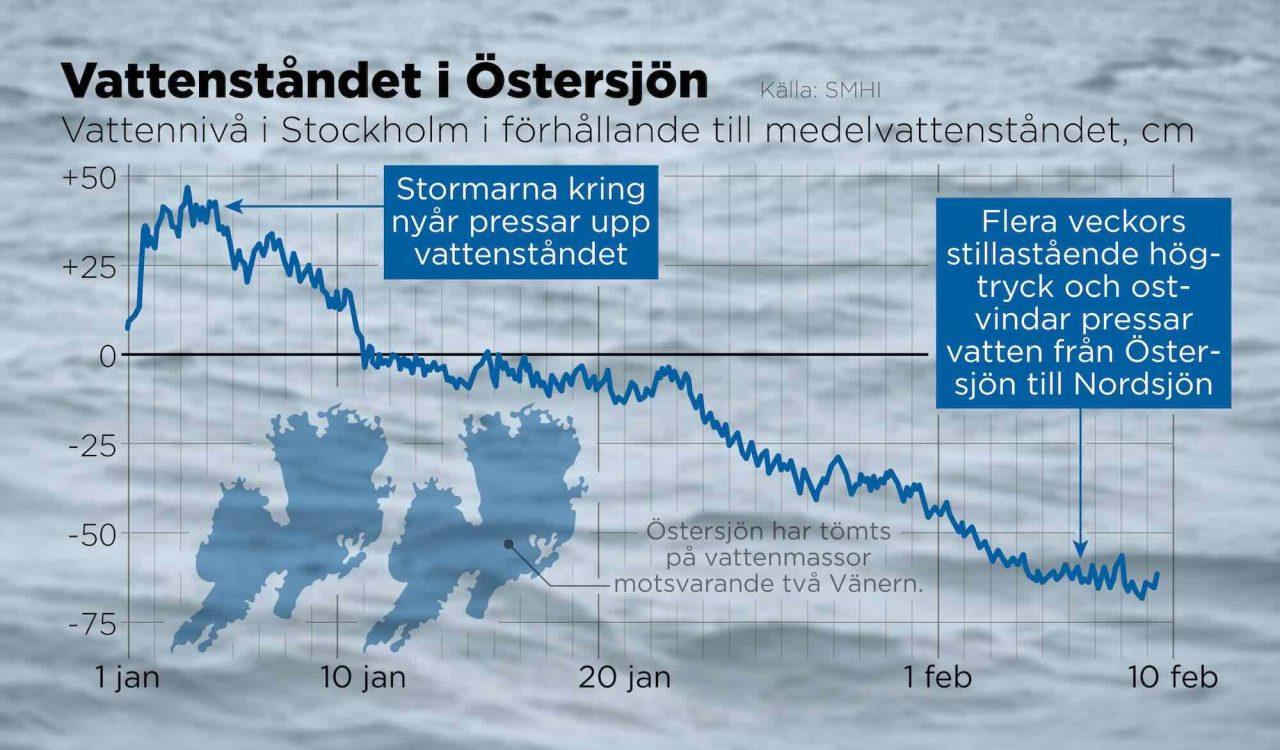
Water level in Stockholm in relation to the average water level, difference in centimetres.
Hoping for ‘autumn weather’
In Finland, several low water records have been broken, and at several Swedish measuring stations, water levels have also fallen to historically low levels.
However, the fact that the Baltic Sea has lost so much water gives some hope for a greater inflow of new, fresh water to the severely oxygen-depleted seabed.
‘The first step – the low levels – has already been achieved. But many steps remain,’ says Jörgen Öberg.
Among other things, it depends on the weather, preferably a longer period of ‘autumn weather’ with low pressure and westerly winds. But it also depends on the type of water.
‘The water must be of sufficiently high quality to be of any use. It must be sufficiently salty, cold and, ideally, have been through a storm so that broken waves have brought oxygen down into the water,’ he says.
Several obstacles
In addition, there are several further obstacles to overcome before the water reaches the deepest points and can be put to good use.
All in all, it’s a bit of a lottery, in other words.
‘We can hope, but there are still many steps to take. The conditions are better than they have been for a long time, but so far we are only in the first step of four or five,’ says Jörgen Öberg.
Cover photo: A shipwreck that is usually hidden beneath the water’s surface has become visible from the quay at Kastellholmen in Stockholm due to the low water level. Photo taken on 5 February. Photo: Magnus Lejhall/TT


