

How Sustainable is the Fish on the Swedish Christmas Table?
The classic Swedish Christmas buffet includes a veritable sea of fish dishes. Herring, gravlax, smoked eel, “lutfisk”, and “Janssons frestelse” are just a few. Deep Sea Reporter examines how these classic dishes fare from a sustainability perspective.
Text: Arvid Wicklander Mellgren
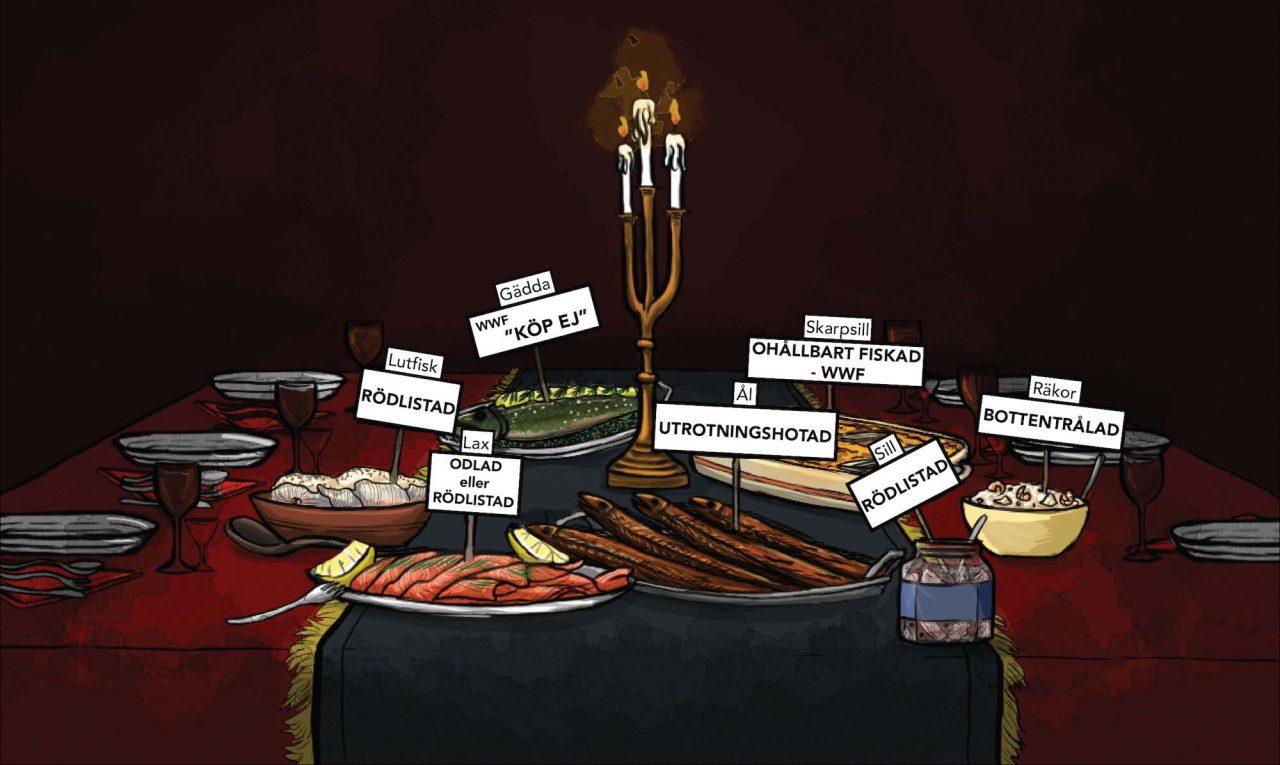
Herring: Red-listed
Perhaps the most classic seafood dish on the Christmas table. Many herring stocks are subject to long-term overfishing, including herring in the Baltic Sea and several stocks in the North Sea. However, there are tins of herring that are considered sustainable according to the World Wildlife Fund (WWF), those with the MSC eco-label. The MSC websitehas a list of MSC-certified herring cans. Herring in Swedish waters was recently red-listed by SLU Artdatabanken and is considered near threatened.
Gravlax: Farmed in open cages – harmful to the environment
Gravlax is another classic on the Christmas table. WWF urges people to only eat farmed salmon from closed, land-based farms in Europe. Wild salmon in Swedish waters has declined sharply in vitality, and salmon farming in open cages in the water can have harmful consequences for the surrounding aquatic environment. Like herring, Swedish wild salmon has recently been red-listed by the Swedish Species Information Centre and is considered near threatened.
Smoked eel: Soon to be protected
Eels in Swedish waters are critically endangered according to the Swedish Species Information Centre. Since 1950, the number of eels in Swedish waters has declined by 95–99 per cent. Eel fishing is completely banned on the west coast, but fishing does occur on the east coast. In addition, there is a major problem with illegal eel fishing. The Swedish Environmental Protection Agency has proposed that the species be protected. WWF urges people to refrain from eating eel altogether.
Lutfisk (made from ling): Refrain altogether, says WWF
“Lutfisk” can be made from different species of fish, but the most common is ling. WWF urges people to refrain from eating trawl-caught ling and, preferably, also to avoid ling caught using other methods in the North-East Atlantic. Ling is listed as endangered by the Swedish Species Information Centre and is considered to be critically endangered. Lutfisk can also be made from other fish species.
Christmas pike: Viable according to the Swedish Species Information Centre
WWF urges people to refrain from buying Swedish pike, but pike from Estonia, for example, is given the green light. According to the Swedish Species Information Centre, pike is viable in Sweden. Pike is also one of Sweden’s most popular fish for sport fishing, but there are rules about where you can fish. In the Baltic Sea, Lake Vänern, Lake Vättern, Lake Mälaren, Lake Hjälmaren and Lake Storsjön, recreational fishing is generally permitted, but certain bays are protected from fishing, meaning that fishing is not allowed there. For smaller lakes, local rules apply.
Anchovies in Jansson’s temptation (on sprat): Shortage in shops ahead of Christmas
What we in Sweden call anchovies are not actually anchovies, but sprats, a small pelagic fish found in both the North Sea and the Baltic Sea. According to Artdatabanken, sprats are viable, but WWF urges people to avoid sprats from the Baltic Sea, where they believe they are being fished unsustainably. During the autumn, there have been reports of a shortage of anchovy tins.
Shrimps: Bottom trawled
The northern prawn, which is the most common edible prawn in Sweden, is red-listed by the Swedish Species Information Centre and is considered to be near threatened. WWF urges people to avoid or completely refrain from eating northern prawns. Most northern shrimp in shops are caught using bottom trawling, which is harmful to the marine environment.
Farmed shrimp are available. The largest sustainability certification for farmed fish and shellfish is the ASC label.
Löjrom (vendace roe): Green light from the Baltic Sea – Avoid from Lake Vänern and Lake Mälaren
A classic Swedish delicacy, commonly served on egg halves during holidays such as Christmas. Vendace is the world’s smallest salmonid fish. It is considered viable by the Swedish Species Information Centre and gets the green light from WWF if it comes from the Baltic Sea. However, WWF urges people to avoid vendace from Lake Vänern and Lake Mälaren.


