

Tension in the Gulf of Finland: Collision with Ferry a Nightmare
Finland has not noticed any reduction in Russian oil exports through the Baltic Sea. However, the risks have increased as the ships in the ‘shadow fleet’ are becoming increasingly dilapidated, and maritime navigation is being disrupted in the narrow Gulf of Finland.
‘The worst-case scenario would be a collision with a fully loaded Finland ferry,’ says Commodore Mikko Simola aboard the patrol vessel Turva.
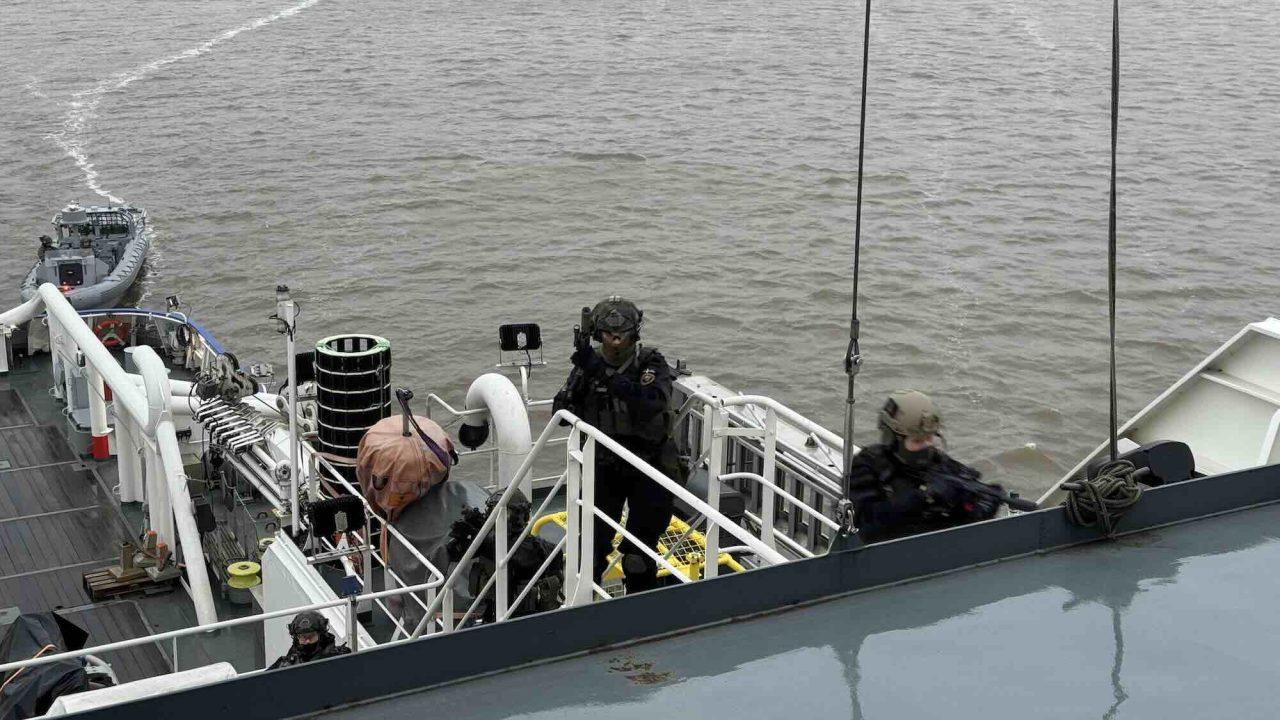
Soldater ur specialtruppenheten under övningen på bevakningsfartyget Turva.
The ultra-modern Turva became world famous as the first ship to reach Eagle S, the tanker loaded with Russian petrol that tore underwater cables apart in Christmas 2024 by dragging its anchor along the bottom of the Gulf of Finland.
Now, about a year later, the Turva is playing the “villain” in an exercise simulating a similar event. The special forces unit, a group of elite soldiers, arrive in small rubber boats and then climb aboard. Quickly and quietly, they make their way up to take over the bridge.
‘They use either inflatable boats or helicopters to reach a suspected vessel,’ says Commander Mikko Simola as he watches with satisfaction.
‘Today the weather is too bad for the helicopter,’ he adds, looking out over the grey, misty Gulf of Finland.

The waters of the Gulf of Finland are crowded.
Worst incident
A helicopter was used to board the Eagle S, and the dramatic video of the boarding was then posted in news reports about the seized vessel. The question of sabotage in this case, and who was behind it, is now being dealt with in the courts.
Eagle S is perhaps the worst incident here since Russia’s major invasion of Ukraine in 2022, but for Finland and Estonia’s border guards, the situation is now constantly tense.
The Eagle S came from Ust-Luga in Russia, which, together with Primorsk, continues to fill President Putin’s war coffers by exporting fossil fuels via the Gulf of Finland and the Baltic Sea to the rest of the world.
‘There are 35-50 tankers per week,’ says Simola.
Sanctions packages from the EU and others against Russia’s ‘shadow fleet’, which have singled out Eagle S, for example, are clearly not helping.
‘We notice that there are constantly “new” ones coming – that is, even older ships that have changed owners, with unclear insurance and unclear ice classification,’ sighs Simola.

Commander Mikko Simola on the bridge of the Finnish border guard vessel Turva.
For just under two years now, the risks have increased further.
‘Starting in the spring of 2024, we are seeing more or less constant satellite disruptions, which are affecting ship navigation.’
A few nautical miles
When asked where the interference is coming from, he nods towards the Russian part of the Gulf of Finland.
‘Well, it’s coming from the east, southeast.‘
The interference makes ships think they are in one place, but in reality they are somewhere else. Simola pulls out a map showing a situation where the coast guard had to contact a cargo ship, which he does not want to name, that was about to sail straight into an island.

The Finnish special forces unit’s rubber boat, used for boarding operations.
The waters of the Gulf of Finland are divided by Finland in the north, Estonia in the south and Russia in the east. At its narrowest point, there are only 40 kilometres between the Finnish and Estonian islands. The international waters preferred by the shadow fleet are just a ‘channel’ in the middle, a few nautical miles wide.
This is where freight traffic, which largely runs in an east-west direction, crosses ferry routes between Sweden, Estonia and Finland.
‘The worst-case scenario would be a collision between a fully loaded Finland ferry and a ship loaded with oil or chemicals,’ says Mikko Simola.

Turva, Finland’s largest border guard vessel, is currently the only one of its kind, but two identical ships are currently under construction.
New money for the war machine
He shows pictures of what the nightmare could look like. They were taken in the Gulf of Oman, between Iran and the Arabian Peninsula, in June this year, and show huge clouds of smoke after the ships Front Eagle and Adalynn collided and caught fire – following similar satellite disruptions that are now occurring in the Baltic Sea.
Adalynn belonged to the Russian shadow fleet and visited the Gulf of Finland as recently as 2024.
Finland and Estonia are working hard to prevent such scenes in the Gulf of Finland. Turva, Finland’s largest border guard vessel, is currently the only one of its kind, but two similar ships are currently being built.
‘The shadow fleet pumps new money into Putin’s war machine every day and is a growing environmental threat,’ said Finnish Prime Minister Petteri Orpo at a summit in Helsinki in mid-December.
‘We have shown that we can respond, but we need to do more. We need more EU sanctions and we also need to turn to other countries – after all, the shadow ships are flagged somewhere.’
The fifth largest country in the EU in terms of area.
It borders Norway to the north, Russia to the east, the Gulf of Finland to the south, and Sweden, the Gulf of Bothnia and the Bothnian Sea to the west.
It has been independent since 1917. Prior to that, it belonged to Russia for over 100 years, and before that it was part of Sweden for over 600 years.
Even since independence, Finland has often had a difficult relationship with its large neighbour to the east. During the Second World War, it was forced to agree to the then Soviet Union taking over almost the whole of Karelia, which faces the Gulf of Finland in the south-east. This meant that Finland lost its second largest city, Vyborg, and an area almost as large as nine Gotlands.
In the 1990s, the then impoverished Russia signalled that Finland could buy back Karelia. However, the costs would be so high that the then President Mauno Koivisto said no.


