Sweden moves towards ratifying Ocean Treaty – last in the Nordics
Since Sweden signed the global ocean treaty BBNJ, the government has said it is working swiftly to ratify it, with the goal of completing the process during 2026. A legislative council referral has now been submitted. But critics argue the matter has still been handled too slowly, and that the target risks being missed.
Text: Amanda Saveland
– It’s probably not going to happen before the turn of the year, says Stina Larsson, environmental policy spokesperson for the Swedish Centre Party.
It was in March 2023 that 193 countries finally agreed on a global ocean treaty at UN headquarters in New York. To loud applause, the chair of the meeting declared, after nearly 40 hours of negotiations, that “the ship has reached shore.”
That ship had been on a very long journey. Work on the ocean treaty — which concerns protecting biodiversity in ocean areas beyond national jurisdiction — began as far back as two decades ago. And even though the ship had now reached shore, it was not yet properly moored.
For the treaty to enter into force, not only a signature was required, but also ratification by at least 60 countries — meaning they would legally commit to implementing what had been agreed.
– It was a crucial phase to get 60 countries to ratify the treaty so it could enter into force, and the EU also pushed for as many member states as possible to do so,” says Jehki Härkönen, political adviser for Greenpeace in Finland.
Only Nordic country not to have ratified
As part of the steering group for the High Seas Alliance — an organisation made up of several groups that have joined forces to push for implementation of the treaty — he has followed the ratification process closely. Finland ratified the treaty in May last year, at the same time as the EU. Denmark and Norway did so the following month, and Iceland half a year later. Sweden, however, still has not.
Despite pressure, Sweden was the only Nordic country not among the 60 countries that brought the treaty into force — a threshold reached in January 2026.
– I think it’s absolutely disgraceful, said Isabella Lövin, member of the European Parliament for the Swedish Green Party, when interviewed by Deep Sea Reporter in July this year.
– The European Commission has done everything to make ratification easier. So I simply think this comes down to the government not prioritising the ocean.
Sharp criticism of the government
According to Isabella Lövin, the government’s handling of the matter has caused Sweden to lose its international leadership on ocean issues — a view she is not alone in holding. The same message has been voiced by Greenpeace as well as other environmental organisations, and has also been raised by other politicians.
Stina Larsson is environmental policy spokesperson for the Swedish Centre Party, and a member of the Committee on Environment and Agriculture. She shares the view that the issue has not received the priority the government promised.
– This treaty didn’t come as any surprise. We’ve known for years that we need to protect our oceans. So I don’t see this as having been handled swiftly — I see it as having dragged on, says Stina Larsson.
Little time left to draft the bill
The government’s stated goal was previously to ratify the treaty before September 2026. That deadline has now been missed, and according to Stina Larsson it is far from certain that Sweden will get the treaty in place before the end of the year. Even though the government submitted a legislative council referral in late August, she points out that it takes time to draft government bills — particularly during an autumn that will be dominated by the upcoming parliamentary election in Sweden.
– Regardless of whether we get it on the table now, it’s going to take time. It has to be reviewed by the committee and go through parliament, so I still think it will be difficult to make it in time, says Stina Larsson.
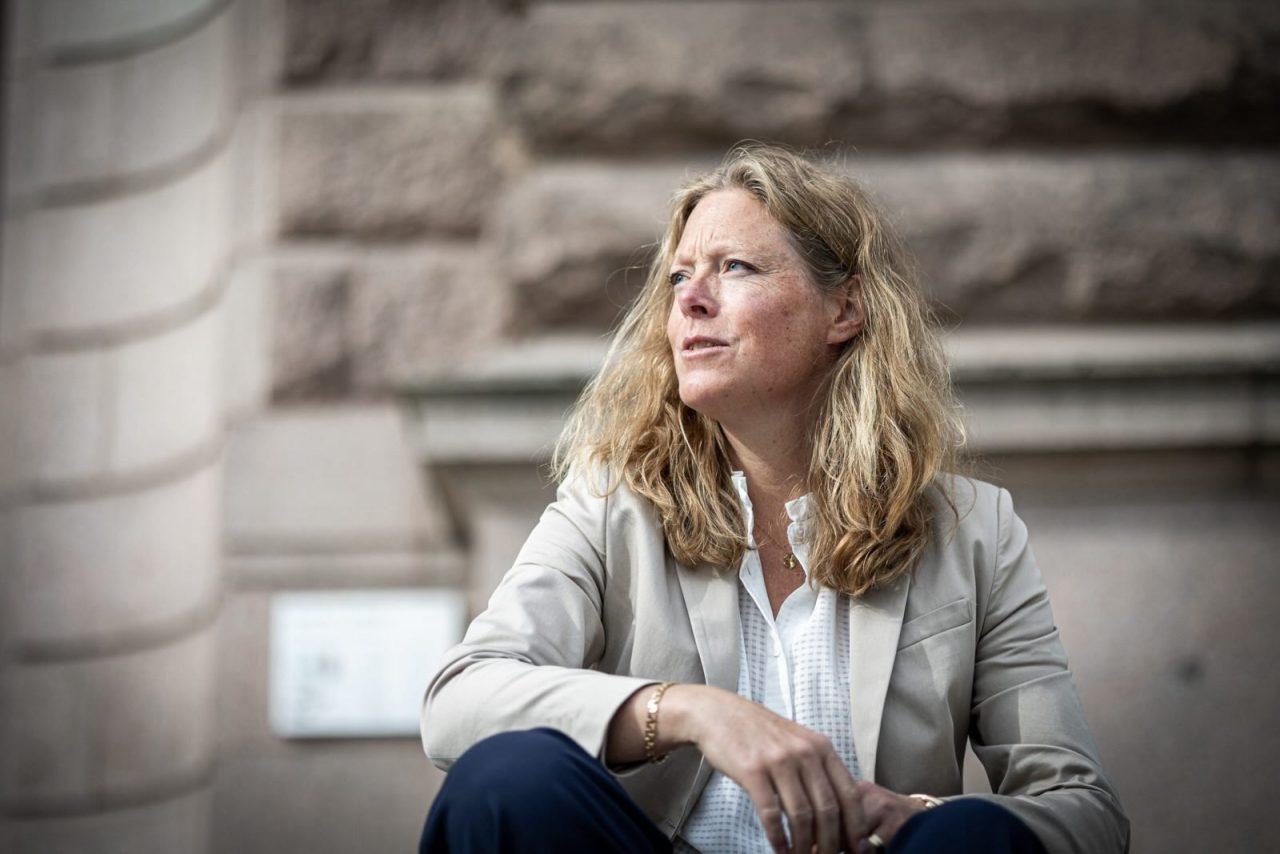
Stina Larsson, environmental policy spokesperson for the Swedish Centre Party, believes the government has not kept its promise to prioritise the ocean treaty.
Sweden is “more ambitious”
There has never been any political disagreement that Sweden should ratify the ocean treaty. Since the meeting in New York in 2023, several ministers have emphasised the importance of the treaty and made clear they want Sweden to join as quickly as possible. What has taken time is the legislative work itself, and that process looks different in Sweden compared with many other EU countries.
– This isn’t about political unwillingness — it’s that Sweden has a legislative tradition of wanting to do things properly, and takes international law seriously, says Niels Krabbe, a researcher in international law at the University of Gothenburg specialising in marine governance.
– Sweden is simply more ambitious. It wants solid legislation in place, rather than just signing and submitting something it can’t be certain of living up to.
Calls the criticism nonsense
As the former official responsible for law-of-the-sea issues at the Swedish Ministry for Foreign Affairs, Niels Krabbe took part in the final negotiations on the treaty, and also served on the committee that examined what legislative changes would be needed for Sweden to ratify it.
He argues that criticism of Sweden being slow is “utter nonsense,” and that the opposite is in fact true — that Sweden is a trailblazer that has taken the legislation a step further.
– I think many of the other EU countries that have ratified the treaty have no idea how to handle these issues domestically. So Sweden can actually become a source of inspiration for them, says Niels Krabbe.
Takes aim at environmental organisations
He points out that most countries that have ratified the treaty so far have introduced domestic legislation that says very little about how it should actually be implemented in practice. That means that once Sweden’s ratification decision finally comes, it is likely to be the first country in the world with a national framework for how environmental impact assessments should be required on the high seas.
According to Niels Krabbe, this — rather than which countries have been fastest to ratify — is what should be the focus. He is therefore highly critical of the environmental organisations that have wanted to speed up the process. He describes it as a “travelling rock festival” or an “armada” of organisations that have toured meetings driving a one-dimensional agenda.
– I think it’s deeply irresponsible and strange that they’ve pushed so hard to speed things up. They should see that it’s in their own interest for this to be implemented ambitiously,” says Niels Krabbe.

Researcher Niels Krabbe, centre, in his former role as the official responsible for law-of-the-sea issues at the Ministry for Foreign Affairs, helped negotiate the UN treaty.
Greenpeace’s response: the clock is ticking
For Jehki Härkönen — political adviser for Greenpeace in Finland and a member of the High Seas Alliance steering group — the criticism seems irresponsible. He points out that the pressure on countries to ratify as quickly as possible existed because that was what was needed for the treaty to enter into force, and that there is very little time left if Sweden and other countries are to meet the goal of protecting 30 percent of the world’s oceans by 2030.
– The ocean treaty is one of our most important tools for reaching that target, and given that we’re already in the second half of 2026, there’s a very clear deadline that countries, including Sweden, have committed to meeting, says Jehki Härkönen.
– Of course no one wants legislation that’s poorly prepared and doesn’t work. But at this point, I still think there would have been time to get it done.
First Conference of the Parties a key deadline
In Finland, the ratification process has moved much faster than in Sweden. A working group was set up shortly after the treaty was signed, and it then took eight months to draft the bill, prepare the matter, and get it approved by parliament.
– I’m well aware that there are different legislative traditions and requirements in different countries, but I still wonder why Sweden didn’t start the process earlier? Because in Finland, we essentially started the day after we signed, says Jehki Härkönen.
It remains to be seen whether Sweden will manage to ratify the treaty before the year is out. If that timeline also slips, there is a significant risk that Sweden will be excluded from the first Conference of the Parties, to be held in New York in January — meaning it would not have a seat at the table when the treaty’s shared rules of procedure are finalised.
But according to Niels Krabbe, Sweden will likely be there after all.
– Provided this is dealt with by parliament reasonably soon this autumn, we’ll make it in time for the first Conference of the Parties. So I think Sweden has every reason to be proud of itself — unless something unexpected happens, says Niels Krabbe.
About Deep Sea Reporter: Our ambition is to examine and report on issues related to the sea and the life that exists beneath its surface. We operate in the public interest and are independent of political, commercial, and other interests in society.