

Weapons in the Fight Against Dead Seas – Wetlands in the Fields
Toxic bathing water, dead fish and dead seabeds – the impact of climate change on the sea is becoming increasingly clear.
But the fight against marine death begins well inland.
‘2018 was a wake-up call,’ says the Swedish farmer Erika Olsson, one of many who have created wetlands.
Between two fields outside the Swedish town Nyköping lies a series of small ponds that resemble a grey-blue mosaic. It looks like something that has been moved from a park, but it is a phosphorus pond – a type of wetland designed to capture excess nutrients from the surrounding land so that they are not transported further to the Sättersta river and ultimately to the already eutrophicated Baltic Sea.
The pond was built in late autumn 2024 and is farmer Erika Olsson’s second wetland. The first is of a different kind, created on a long, narrow plot of land that used to be a field, but where no real harvest was ever achieved. Today, a shallow pool of water glistens, and at the edge you can see hoofprints from deer and elk that have come to drink.
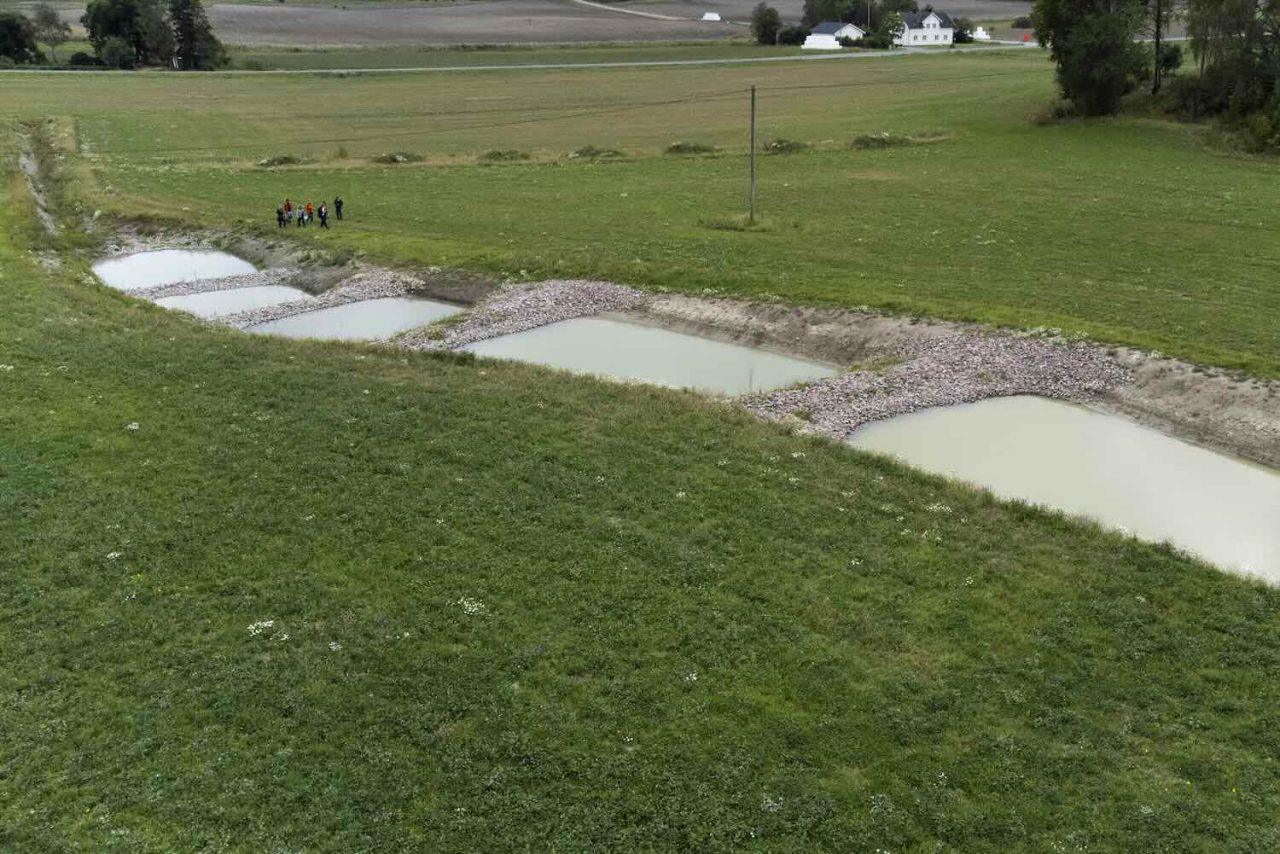
The phosphorus dam captures excess nutrients from the soil so that they do not leak into the Baltic Sea.
Great interest
The dry and hot summer of 2018 made her start thinking about water in a new way.
‘2018 was a wake-up call for me. We sowed twice and got no harvest. We had no feed for the animals, we called the slaughterhouses and they were full. If we are to be more long-term in our farming, we need to get more water in’.
She is not alone in Sweden. There is considerable interest among farmers in creating wetlands, says Markus Hoffman, sustainability expert at LRF, both as a climate measure and simply because they are beautiful to look at.
When LRF asked its members about their attitude to wetlands, many responded that they would be happy to create them if they received help with planning, administration and applying for permits and funding.
Erika Olsson received help from the Nyköping rivers Water Conservation Association and the EU project BaltCOP. These organisations include some of the country’s 50 or so local action coordinators, who help farmers with project planning and navigating the jungle of permits and subsidies.
‘It’s a new invention in Sweden that has proven to work,’ says Markus Hoffman.

Erika Olsson created the first wetland in autumn 2024. A year later, she feels as though it has always been there. Here she is with Gordon Lindau, coordinator at the Nyköping rivers Water Conservation Association, who helped with the project.
Unfairly singled out
Eutrophication in lakes and seas occurs when the plant nutrients nitrogen and phosphorus leak out. In the Baltic Sea, this amounts to around 100,000 tonnes of nitrogen and 3,000 tonnes of phosphorus per year. Agriculture is the main cause of nutrient leakage leading to eutrophication, but transport, emissions from sewage treatment plants and industry also contribute to the emissions that affect marine ecosystems.
‘Many farmers often feel unfairly singled out as environmental villains,’ says Markus Hoffman.
First in the 1980s and 90s with the issue of eutrophication and nutrient leakage, and now 30 years later, they are not only environmental villains but also climate villains. Wetlands are a measure that everyone can understand.
But the great thing about wetlands is that they are multifunctional. Many environmental and climate measures in agriculture may only benefit the climate or only benefit water purification, but with wetlands, you can tick all the boxes. In that sense, you could say that wetlands rarely go wrong.


